
Contents
A quick guide to comparing business accounts in Switzerland
Choosing a business account in Switzerland used to be mostly about banking: account fees, cards, payments and access to a branch. Today, the choice is much broader. Traditional banks still offer familiar business banking services, while a new generation of digital platforms combines banking with accounting, invoicing, payroll and financial management.
That means the cheapest business account isn't necessarily the best-value account - and the right choice depends increasingly on how you want to run your business, not simply where you want to bank.
Whether you’re starting your business in Zurich, Geneva, Lausanne or Zug, and whether you’re forming a GmbH or AG, many of the decisions you'll need to make will follow the same process.
Comparing the best business accounts for Swiss businesses
Opening a business account is one of the first financial decisions every entrepreneur makes. Whether you're launching a new company or switching providers, choosing the right account can save time, reduce administration and make managing your business finances much easier.
Switzerland's business banking market spans traditional cantonal banks, pan-European neobanks, and a new generation of all-in-one financial platforms, each with a different view of what a business account should do. Knowing which is right for your business, and for a Swiss company specifically, isn't always straightforward.
We compared the most relevant Swiss business account providers so you don't have to. This comparison explains what to look for, how the providers stack up, and helps you decide which solution best fits your business, whether you're a freelancer, a newly incorporated GmbH, or a growing SME.
Not all business accounts are created equal. Some focus purely on banking, while others combine accounting, invoicing and financial management into a single platform.
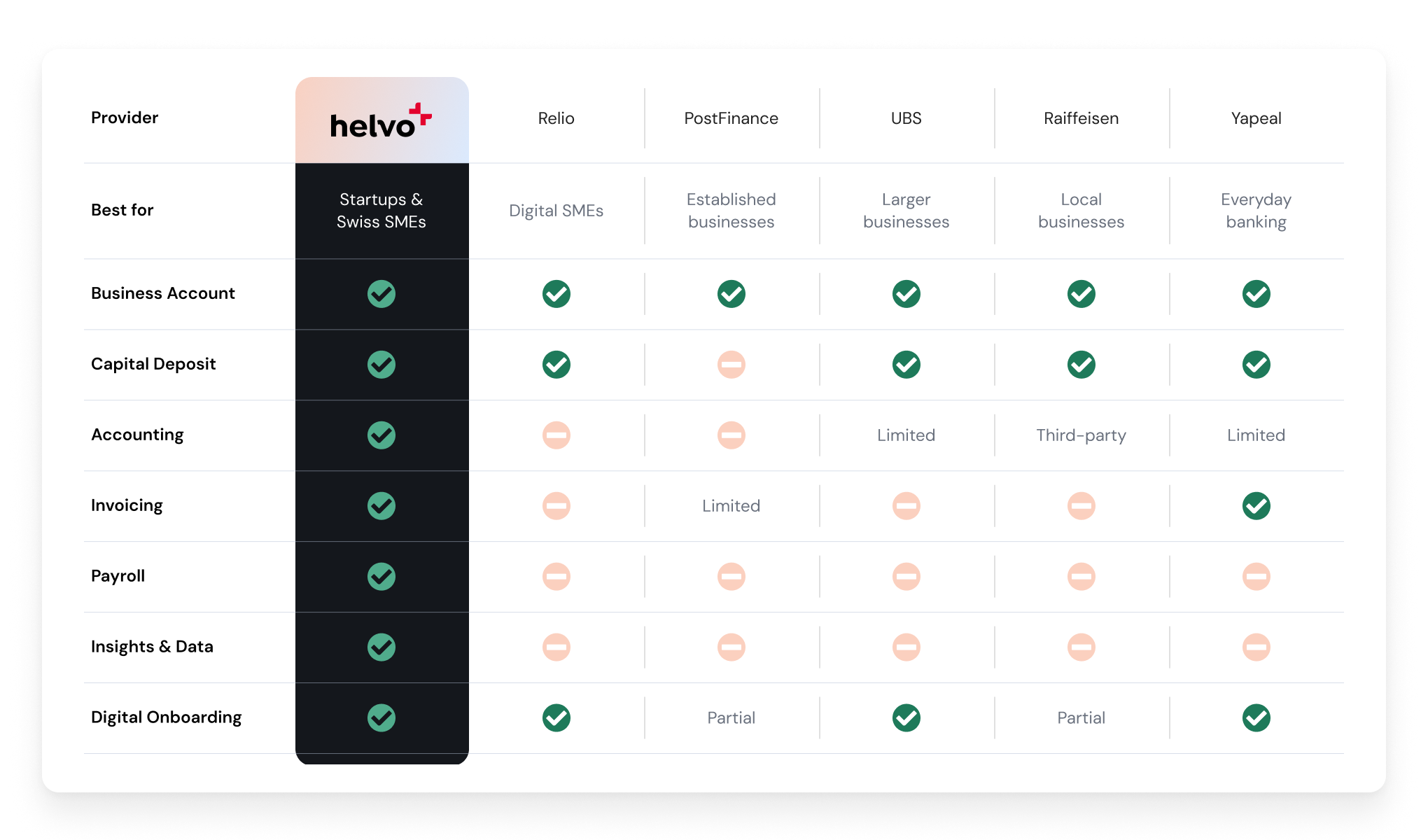
What should you look for in a business account?
Choosing a business account isn't just about finding the lowest monthly fee. The right account should support the way your business operates today while giving you room to grow tomorrow.
Fees and day-to-day costs
Most providers charge differently. Some have monthly account fees, while others charge for payments, additional cards or international transfers. Before making a decision, compare the total cost of running your business finances - not just the headline monthly price.
How quickly you can get started
If you're starting a business in Switzerland, speed matters. Opening a business account is often one of the final steps before you can begin trading. Some providers still require appointments and paperwork, while others - like Helvo - offer a fully digital process. If you're forming a GmbH or AG, consider providers that offer both a capital deposit account and an operational account, so the transition from formation to trading is seamless.
Integration with accounting
For many Swiss businesses, banking and accounting still live in separate systems - exporting statements, reconciling transactions manually, switching between tools. Modern financial platforms remove those extra steps by combining banking and accounting in one place.
Scaling with your business
Your needs today won't be the same in twelve months. As your business grows, you may need invoicing, payroll, expense management and better financial reporting. Choosing a provider that supports those next steps avoids costly platform switches later.
Traditional banks or digital business platforms?
Swiss businesses now have more choice than at any point in recent history. Traditional banks continue to offer trusted business accounts backed by established infrastructure. For many businesses - particularly larger organisations - this remains the right choice.
At the same time, a new generation of digital providers is changing what founders expect from business banking. Rather than simply offering an account, these platforms help entrepreneurs manage more of their financial operations in one place, from company formation and invoicing through to accounting and financial reporting.
The right choice depends on your business. If you're looking for a straightforward account, a traditional bank may meet your needs. If you're looking to reduce administration and simplify your financial operations, an integrated platform is likely to offer greater long-term value.
Why more Swiss SMEs are choosing integrated financial platforms
Running a business already involves enough moving parts. Your finances shouldn't be one of them.
Many Swiss businesses still rely on separate providers for banking, accounting, invoicing and payroll. While each tool solves a specific problem, switching between multiple systems creates more work than it removes. Integrated financial platforms take a different approach - bringing together the tools businesses use every day into one connected experience.
For founders, that can mean:
- Less manual administration
- Fewer systems to manage
- Better visibility of cash flow and financial position
- Faster financial close and VAT reporting
- More time to focus on customers and growth
Understanding whether you need more than a business account
Most Swiss providers can give you an account, cards and a way to make payments. So those features alone don't necessarily tell you which provider will make running your business easier.
The more useful questions are:
- How much financial administration will I still need to do outside the platform?
- Will my banking and accounting work together?
- Can I invoice customers, manage payroll and understand my cash flow in the same place?
- Will the platform still work for me as my business grows?
For a freelancer who simply needs somewhere to receive payments, a straightforward business account may be enough. For a growing SME, reducing the number of systems used to manage its finances can be considerably more valuable than saving a few francs on the monthly account fee.
How to open a business account in Switzerland
Opening a Swiss business account is usually straightforward once your company has been incorporated. In most cases you'll need:
- Company registration details
- Commercial Register extract, where applicable
- Identification for directors or authorised signatories
- Company statutes (for GmbH and AG structures)
The exact requirements vary between providers. Digital platforms generally offer a faster onboarding experience than traditional banks.
If you're still forming your company, you'll need to open a Capital Deposit Account first - before your operational business account can be activated.
FAQ — Frequently asked questions about Swiss business accounts
What should I look for in a bank account for a new Swiss GmbH?
If you operate a GmbH or AG, opening a dedicated business account is strongly recommended and required during the company formation process. Even sole traders benefit from keeping personal and business finances separate - it makes accounting and tax reporting significantly simpler.
Can I open a business account online?
Many providers allow you to start the application online, although the process varies. Digital-first platforms typically offer a faster experience than traditional banks, reducing paperwork and helping new businesses get operational sooner.
How much does a Swiss business account cost?
Monthly fees vary between providers. Some accounts charge a monthly base fee; others charge per transaction or for additional services. It's important to compare total cost of ownership — not just the headline monthly price. You can find Helvo's pricing here.
Which business account is best for startups?
The best business account for a Swiss startup is usually one that combines fast digital onboarding, transparent pricing and tools that reduce financial administration. Choosing a platform that combines business banking with accounting and invoicing allows founders to spend less time on financial admin and more time growing their business.
Which business account is best for small businesses?
Established small businesses often benefit most from solutions that provide visibility over cash flow, simplify financial processes and reduce the need for multiple disconnected tools. Integrated platforms that connect banking, invoicing and accounting are increasingly the preferred choice.
What is a capital deposit account?
A capital deposit account holds the share capital required to form a GmbH (CHF 20,000 minimum) or AG (CHF 100,000 minimum) during the Swiss company registration process. Once the company has been entered in the Commercial Register, the capital is released and the account can be converted into your operational business account. Some providers - including Helvo - offer both in one place.
About the author

Share