Contents
Learn what a Swiss invoice needs to contain, including required information, VAT, payment terms and QR-bills. A practical guide for Swiss SMEs.
Sending an invoice should be one of the simplest parts of running a business. You’ve done the work, delivered the product or service and now you need to get paid.
But what information should a Swiss invoice contain? What changes if your business is VAT-registered? And where does the Swiss QR-bill fit in?
Here’s what Swiss SMEs need to know.
What should you include on a Swiss invoice?
A good invoice makes it immediately clear who is billing whom, what the customer is paying for, how much they owe and how they should pay.
As a practical starting point, your invoices should clearly identify:
- Your business
- Your customer
- The invoice date
- What goods or services you supplied
- When those goods or services were supplied
- The amount payable
- The applicable VAT information, if your business is VAT-registered
- The payment information your customer needs
It’s also good practice to give each invoice a unique invoice number and state a clear payment due date. These make invoices easier to track, reconcile and follow up.
For VAT-registered businesses, invoice information matters particularly because invoices support the correct treatment of VAT by both supplier and customer. The Swiss Federal Tax Administration (ESTV) sets out the applicable Swiss VAT and invoicing requirements.
The simplest rule is: make it easy for your customer to understand the invoice and easy for both businesses to account for it correctly.
What changes on an invoice if your business is VAT-registered?
If your business is registered for Swiss VAT, your invoice needs to correctly identify the supplier and show the applicable tax information. Depending on the transaction and how prices are presented, the appropriate VAT rate and treatment also need to be clear.
VAT rules can vary depending on the transaction, so don’t guess if you’re unsure about the treatment of a particular product, service or customer. The Swiss Federal Tax Administration should be your reference point for current VAT requirements.
What payment terms should you put on an invoice?
Don’t make your customer work out when you expect to be paid. State a clear due date or payment term on every invoice.
For example:
Payment due within 30 days of the invoice date.
Whatever terms you agree, consistency matters. Your invoice should reflect the commercial terms agreed with your customer, and your business should have a clear process for monitoring unpaid invoices.
This becomes increasingly important as you grow.
Revenue recorded on an invoice isn’t the same thing as cash in your account. Knowing which invoices are outstanding - and for how long - is an important part of managing healthy cash flow.
What is a Swiss QR-bill?
The QR-bill is a standard used for invoicing and payments in Switzerland and Liechtenstein.
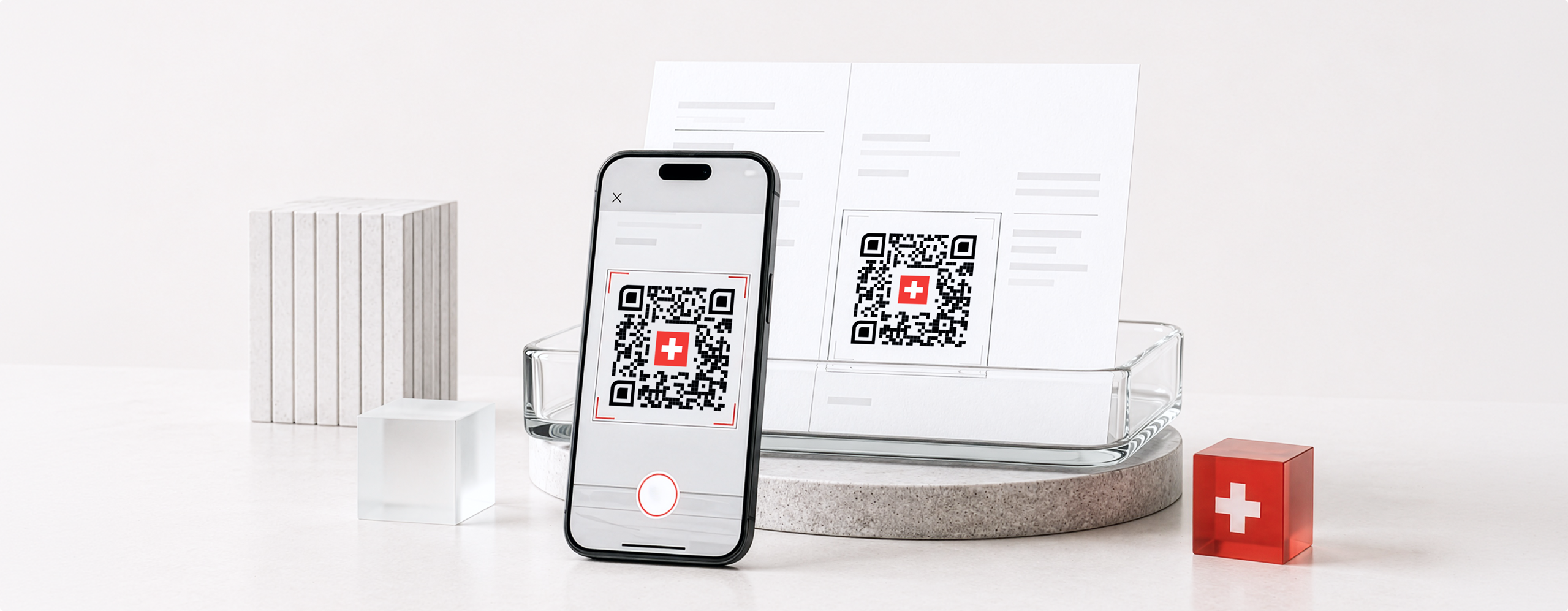
Its most recognisable feature is the Swiss QR Code - a QR code with a Swiss cross in the centre.
The QR-bill contains the payment information required to make a payment in both machine-readable and human-readable form. A customer can scan the code using a supported banking application, review the payment details and approve the payment without manually entering all of the information.
SIX maintains the official Swiss QR-bill standard and technical specifications.
The QR-bill replaced the old Swiss payment slips in 2022.
For SMEs, the benefit is straightforward: make it easier for customers to pay correctly and make incoming payments easier to process and reconcile.
What information does a QR-bill contain?
A QR-bill consists of a payment section and a receipt. The payment section contains the key information needed to make the payment, such as:
- who is being paid
- the IBAN or QR-IBAN
- the amount and currency, where specified
- the payment reference, where applicable
- details of the person or business making the payment, where required
The Swiss QR Code contains the relevant payment information digitally. The key details are also displayed in readable form, so the person making the payment can check them before approving the transaction.
Depending on the setup, a QR-bill can use different combinations of IBAN and payment reference. The format must follow the technical specifications established for Swiss payment processing.
Importantly, since 22 November 2025, QR-bills need to use structured address information in the Swiss QR Code. At this time they also introduced an extended character set supporting additional umlauts and special characters.
For an SME, the practical point is simple: your invoicing solution needs to support the current Swiss QR-bill standard.
With Helvo, QR-bills form part of the invoicing process within the platform.
Create and manage your invoices with Helvo →
Common invoicing mistakes to avoid
Even relatively small invoicing errors can create unnecessary administration or delay payment:
- Missing or incorrect customer details - Check who the invoice should be addressed to before sending it.
- Unclear descriptions - The customer should be able to understand what they’re being charged for.
- Incorrect VAT information - If you’re VAT-registered, make sure the applicable information is shown correctly.
- No clear payment deadline - Tell the customer when payment is expected.
- Incorrect payment details - An invoice can’t do its job if the customer doesn’t know where to send the money.
- Using outdated QR-bill data or formats - Current QR-bill specifications need to be followed. Incorrectly produced QR-bills can create processing problems. The latest specifications are available directly from SIX.
And finally: don’t wait until an invoice is overdue to think about how you’ll track it.
What happens after you send an invoice?
Creating the invoice is only the beginning of the process. Ideally, you should be able to follow a simple journey:
Invoice issued → payment due → payment received → transaction matched → accounts updated
When these steps happen across several disconnected systems, even a simple payment can create work.
If you have the invoice in one tool, the incoming payment in your bank account and the accounting entry somewhere else, someone has to manually connect the dots. That might be manageable when you’re sending five invoices a month, but at 50 or 500, it’s a different story.
This is why invoicing should be considered as part of your wider financial workflow rather than as an isolated administrative task.
Bring invoicing, payments and financial management together
Helvo is designed to help Swiss SMEs manage more of their financial operations in one place.
Instead of treating an invoice as a document that sits separately from your banking and accounting, Helvo brings invoicing, payments, business banking and financial management into the same environment.
That means less time moving information between systems and a clearer view of what’s happening across the business.
Frequently asked questions about Swiss invoices
What information should be on an invoice in Switzerland?
An invoice should clearly identify the supplier and customer, describe what was supplied and when, state the amount due and provide the information required for payment.
VAT-registered businesses also need to include the appropriate VAT information in accordance with current Swiss requirements. The Swiss Federal Tax Administration provides the authoritative guidance on VAT.
Does a Swiss invoice need an invoice number?
Using a unique invoice number is good business and accounting practice because it makes invoices easier to identify, track and reconcile.
What is a Swiss QR-bill?
A QR-bill contains payment information in a Swiss QR Code as well as in readable text. It is designed to make payment and subsequent processing simpler. The technical standard is maintained by SIX.
Can a QR-bill be sent as a PDF?
Yes. QR-bills can be issued digitally, although specific requirements apply if a PDF is subsequently printed and used for paper-based payment processing. SIX provides the current specifications and guidance.
Do I need to include VAT on every invoice?
Not necessarily. VAT treatment depends on whether your business is VAT-registered and on the transaction concerned.
If you’re unsure, refer to the Swiss Federal Tax Administration’s current VAT guidance rather than making assumptions about the correct treatment.
This article provides general information and does not constitute legal, tax or accounting advice. Requirements may depend on the individual transaction and circumstances of your business. Refer to the Swiss Federal Tax Administration and other relevant official authorities where appropriate.
About the author

Share